Fall Protection for Roofing Crews — OSHA 1926 Subpart M
The system OSHA actually requires once a worker is 6 feet or higher on a roof — guardrails, safety nets, personal fall arrest systems, and warning lines, broken down by low-slope vs. steep-slope work.
Request Your Program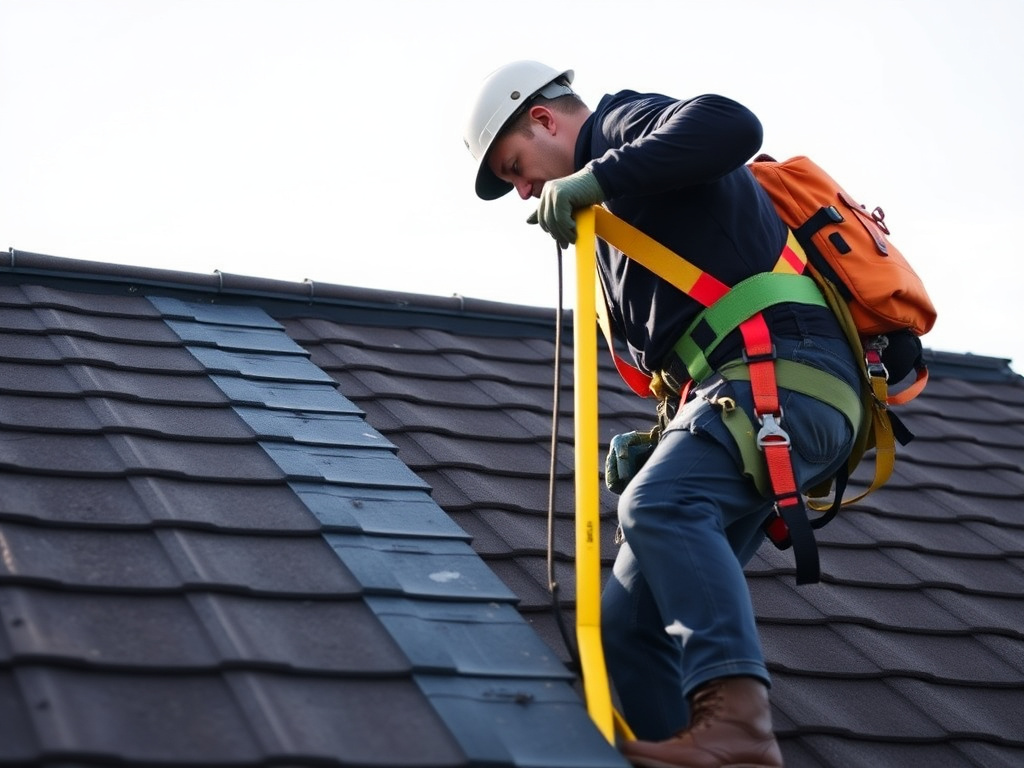
The 6-foot rule
Under 29 CFR 1926.501, any employee working on a roof with an unprotected side or edge 6 feet (1.8 m) or more above a lower level must be protected from falling — this is the single trigger height that governs almost every fall-protection decision on a roofing jobsite.
What changes below that trigger height is a separate question from whether it's safe. OSHA's roofing-specific fall-protection duty is keyed to the 6-foot threshold, but a competent person should still evaluate lower-height work for other hazards (holes, unstable surfaces, ladder access) before assuming no protection is needed.
Low-slope roofs — four options
On low-slope roofs, 1926.501(b)(10) gives crews four compliant paths: guardrail systems, safety net systems, personal fall arrest systems (PFAS), or a warning line system used in combination with guardrails, safety nets, or a PFAS.
A fifth option — a safety monitoring system used alone, with no warning line — is permitted only on low-slope roofs 50 feet or less in width. Above that width, a monitor alone is not a compliant substitute; it has to be paired with a warning line or one of the physical protection systems.
Steep roofs — no warning-line shortcut
Steep roofs are governed separately under 1926.501(b)(11), and the option set is narrower: guardrail systems (with toeboards), safety net systems, or personal fall arrest systems. Warning line systems and safety-monitor-alone systems are not compliant options on a steep roof — the pitch itself removes those choices from the table.
Warning line system specs — 1926.502(f)
When a warning line is part of the plan, its geometry is spelled out precisely: the line has to be erected not less than 6 feet from the roof edge where no mechanical equipment is in use. Where mechanical equipment is being used, the line moves to not less than 6 feet from the edge parallel to the equipment's direction of travel, and not less than 10 feet from the edge perpendicular to that travel.
The line itself has to sag between 34 and 39 inches above the walking/working surface at its lowest point, be flagged with high-visibility material at intervals no greater than 6 feet, and surround every side of the roof work area that has an unprotected edge.
Holes and skylights count as fall hazards
1926.501(b)(4) requires protection from falling through any hole more than 6 feet above a lower level — and OSHA explicitly treats skylights as holes, even when the glazing looks intact. Aged or damaged skylight glazing frequently cannot support a worker's weight, so a covered or guardrailed skylight is treated the same as an open hole in the deck.
A compliant cover has to support at least twice the weight of the workers, equipment, and materials that could reasonably be imposed on it at any one time, be secured against displacement, and be marked "HOLE" or "COVER" so it isn't mistaken for solid decking by the next person on the roof.
Why this is the standard OSHA cites most
Fall protection — general requirements has been OSHA's #1 most-cited standard across all industries for 15 consecutive years, and roofing contractors are consistently the industry most represented in that citation count. In April 2023, OSHA launched its first-ever National Emphasis Program focused specifically on falls (CPL 03-00-025), which authorizes compliance officers to open an inspection whenever they observe someone working at height — including incidentally, while driving past a jobsite, not only during a planned inspection.
A written, on-file program is necessary but not sufficient. What holds up during an inspection is a program your crew can describe in their own words and that matches what the compliance officer actually sees happening on the roof.
Key facts
- Trigger height
- 6 feet
- Governing standard
- 29 CFR 1926.501
- Warning line specs
- 29 CFR 1926.502(f)
- OSHA rank, FY2025
- #1 most-cited standard
Fall-protection systems at a glance
| System | Low-slope roofs | Steep roofs | Notes |
|---|---|---|---|
| Guardrail system | Yes | Yes (with toeboards) | Physical barrier at the edge; no worker action required to stay protected |
| Safety net system | Yes | Yes | Positioned to catch a fall; must be inspected and load-tested per manufacturer spec |
| Personal fall arrest system (PFAS) | Yes | Yes | Harness + anchor + connector; requires trained use and a rescue plan |
| Warning line + guardrail/net/PFAS | Yes | Not permitted | Warning line alone is never sufficient — always paired |
| Safety monitor system alone | Only if roof ≤ 50 ft wide | Not permitted | Narrowest exception in the standard; easy to misapply |
Related program areas
FAQ: Fall Protection
Yes, but only on low-slope roofs that are 50 feet or less in width, and never on steep roofs. Above that width, or on any steep-slope roof, a safety monitor has to be paired with a warning line system or one of the physical protection systems — it can't stand alone.
OSHA's roofing fall-protection trigger height is 6 feet. Below that height, the specific duties in 1926.501(b)(10) and (b)(11) generally don't apply, but a competent person should still evaluate the work area for other hazards — unstable surfaces, holes, and ladder access don't disappear just because the edge is under 6 feet.
Yes. OSHA treats skylights as "holes" under 1926.501(b)(4) regardless of whether the glazing appears intact, because aged or weathered glazing frequently can't support a worker's weight if fallen on. Skylights need a compliant cover, guardrail, or PFAS protection just like any other roof opening.
Not less than 6 feet from the edge where no mechanical equipment is in use. If mechanical equipment is being used near the edge, the line has to be at least 6 feet from the edge parallel to the equipment's travel and at least 10 feet perpendicular to it, per 1926.502(f).
- Is a safety monitor system alone ever allowed on a roof?
- Do I need fall protection under 6 feet?
- Are skylights considered fall hazards even if the glass looks solid?
- How far from the roof edge does a warning line have to be?
Get your fall protection program documented
Plain-language, OSHA-aligned, and built for your crew.