Roof-Edge & Skylight Fall Protection
The two most commonly missed fall hazards on a roofing jobsite aren't exotic — they're the edge everyone gets used to walking near, and the skylight everyone assumes is solid.
Request Your Program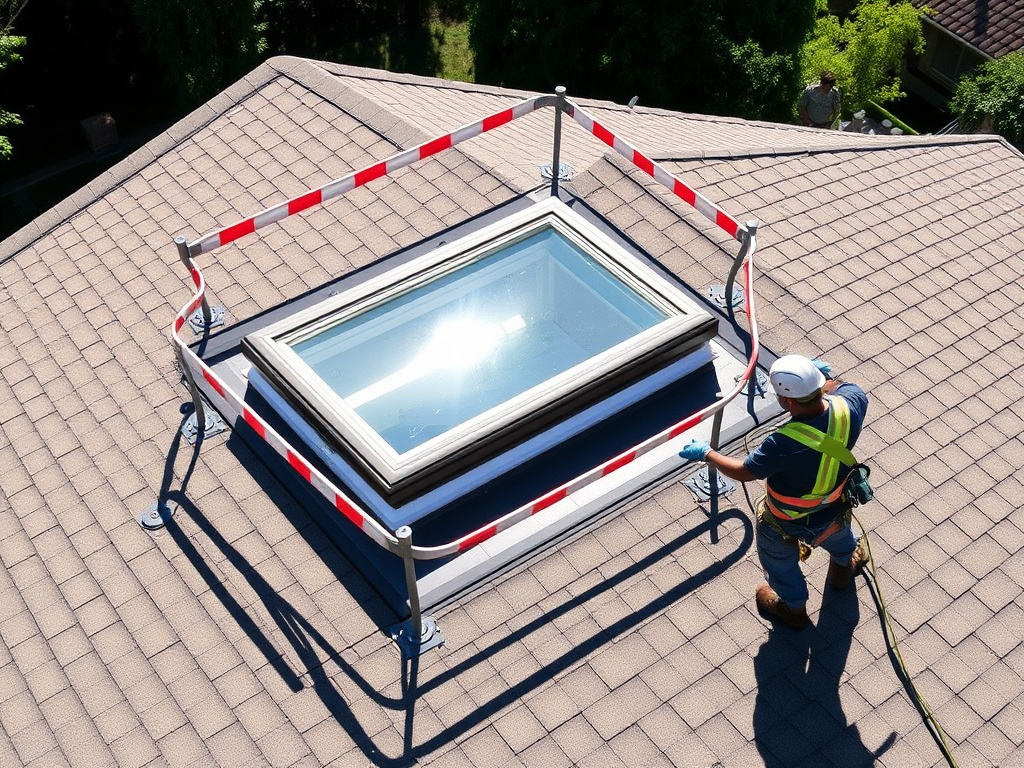
Roof-edge protection isn't optional past 6 feet
Any unprotected roof edge 6 feet or more above a lower level triggers the same fall-protection duty covered on our fall-protection page: guardrails, safety nets, PFAS, or (on qualifying low-slope roofs) a warning line system used in combination with one of those. Crews that work the same roof edge repeatedly over a multi-day job are the ones most likely to get comfortable with an unprotected edge — familiarity is a real risk factor, not just a compliance gap.
Skylights are treated as holes, not features
OSHA's 1926.501(b)(4) hole-protection requirement explicitly covers skylights, even ones that look structurally sound from the surface. The reasoning is straightforward: skylight glazing degrades with UV exposure and weather over time, and a worker's body weight landing on a compromised panel is enough to break through. OSHA's own standard-interpretation guidance on skylight covers backs this up directly.
A compliant skylight cover has to support at least twice the weight that could reasonably be imposed on it — by workers, tools, or materials — has to be secured so it can't be displaced or removed accidentally, and has to be marked "HOLE" or "COVER" so nobody mistakes it for load-bearing decking on a later pass across the roof.
Anchor point placement near edges and skylights
When a personal fall arrest system is the chosen protection method near a roof edge or skylight, anchor point location matters as much as the harness itself. An anchor placed too far from the hazard can allow enough swing-fall distance for a worker to strike the edge or an adjacent skylight during a fall arrest event. Anchor placement should be planned before work starts, not improvised at the point of use.
Key facts
- Hole/skylight standard
- 29 CFR 1926.501(b)(4)
- Cover load rating
- 2x imposed weight, minimum
- Cover marking
- "HOLE" or "COVER"
- Edge trigger height
- 6 feet
Related program areas
FAQ: Roof-Edge & Skylight
Yes. OSHA treats all skylights as holes under 1926.501(b)(4) regardless of how the glazing looks, because aged or weathered panels frequently can't support a worker's weight. A cover, guardrail, or PFAS is required.
The cover has to be marked "HOLE" or "COVER" so it's clearly identified as a fall hazard barrier rather than solid decking, in addition to meeting the load and securement requirements in 1926.501(b)(4).
No — anchor placement needs to account for swing-fall distance so a worker arresting a fall can't strike the roof edge or a nearby skylight. Plan anchor locations before work starts rather than at the point of use.
- Do intact-looking skylights still need fall protection?
- What has to be written on a skylight or hole cover?
- Can a PFAS anchor be placed anywhere near a roof edge?
Get your roof-edge & skylight program documented
Plain-language, OSHA-aligned, and built for your crew.