Warning Line Systems vs. Guardrails: Choosing Roof Fall Protection the Right Way
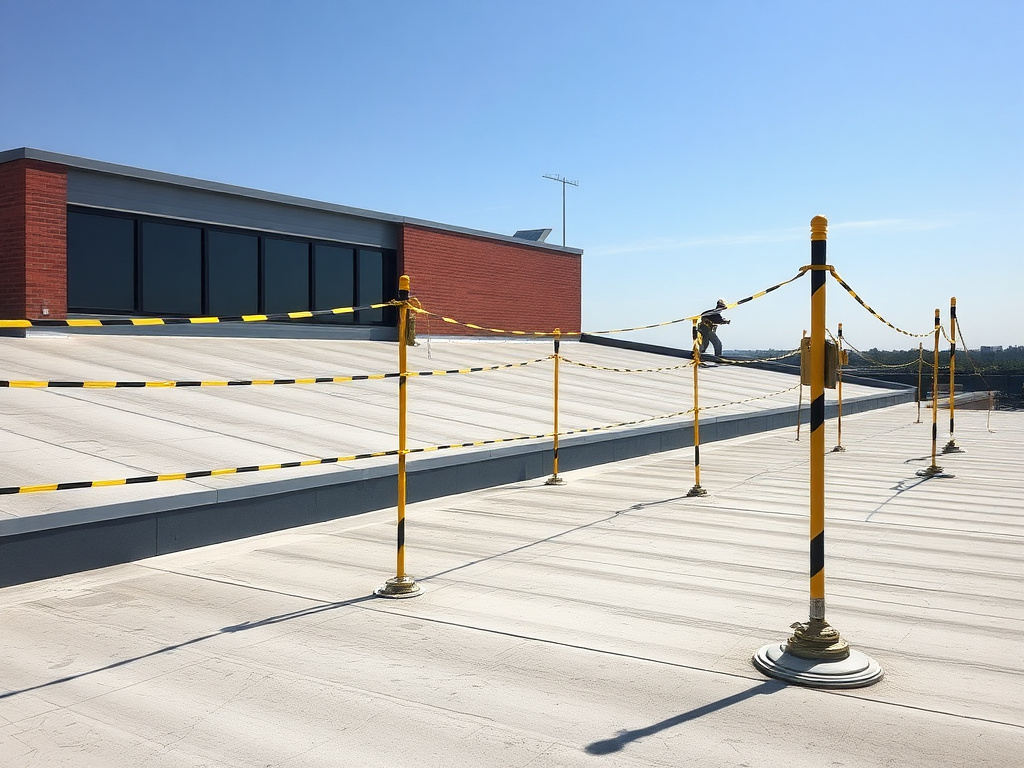
One of the most common misunderstandings on a roofing jobsite is treating warning line systems as a stand-alone substitute for guardrails or a personal fall arrest system (PFAS). Under 29 CFR 1926.501(b)(10), a warning line is only ever a compliant option on a low-slope roof, and only when it's used in combination with guardrails, safety nets, or a PFAS — or paired with a safety monitor on roofs 50 feet wide or less. It is never a stand-alone system on its own, and it's not a legal option on a steep roof at all.
What a compliant warning line actually looks like
Per 29 CFR 1926.502(f), the line has to be erected not less than 6 feet from the roof edge when no mechanical equipment is being used nearby. If mechanical equipment is in use, the required distance changes: not less than 6 feet from the edge parallel to the equipment's direction of travel, and not less than 10 feet perpendicular to that travel. The line itself needs to sag between 34 and 39 inches above the roof surface at its lowest point, be flagged with high-visibility material at intervals no greater than 6 feet, and enclose every side of the work area with an unprotected edge.
Guardrails: the most predictable option
A properly built guardrail system is compliant on both low-slope and steep roofs, and on steep roofs it has to include toeboards. Its main advantage is that it protects passively — a worker doesn't have to take any action (clipping in, staying inside a line) to remain protected, which removes a category of human-error risk the other systems carry.
Safety nets and PFAS: active systems that require training
Safety net systems and personal fall arrest systems are compliant on both roof types, but both require more from the crew than a guardrail does. Nets need to be correctly positioned and load-rated for the work above them; a PFAS requires a properly rated anchor, correctly rigged connectors, trained use, and — critically — a rescue plan, since arresting a fall is not the same as resolving one. A worker left suspended in a harness after a fall arrest is still in danger if rescue isn't planned and fast.
The safety monitor exception is the easiest one to misapply
A safety monitor system used alone — no warning line, no physical barrier — is the narrowest exception in the standard. It's permitted only on low-slope roofs 50 feet wide or less, and it depends entirely on the monitor's ability to see every worker, communicate hazards clearly, and have the authority to stop unsafe work immediately. On any wider low-slope roof, or any steep roof, this option simply isn't available — a warning line or physical system has to be used instead.
Choosing the right system for a given job
In practice, the decision usually starts with roof pitch (steep vs. low-slope), then roof width (for the monitor-alone exception), then the practical realities of the specific job — how long the crew will be up there, whether mechanical equipment is involved, and whether the crew is trained and equipped for PFAS rescue. A written, site-specific plan that documents which system applies and why is what an inspector — and more importantly, a supervisor walking the job — should be able to check against reality in seconds.